
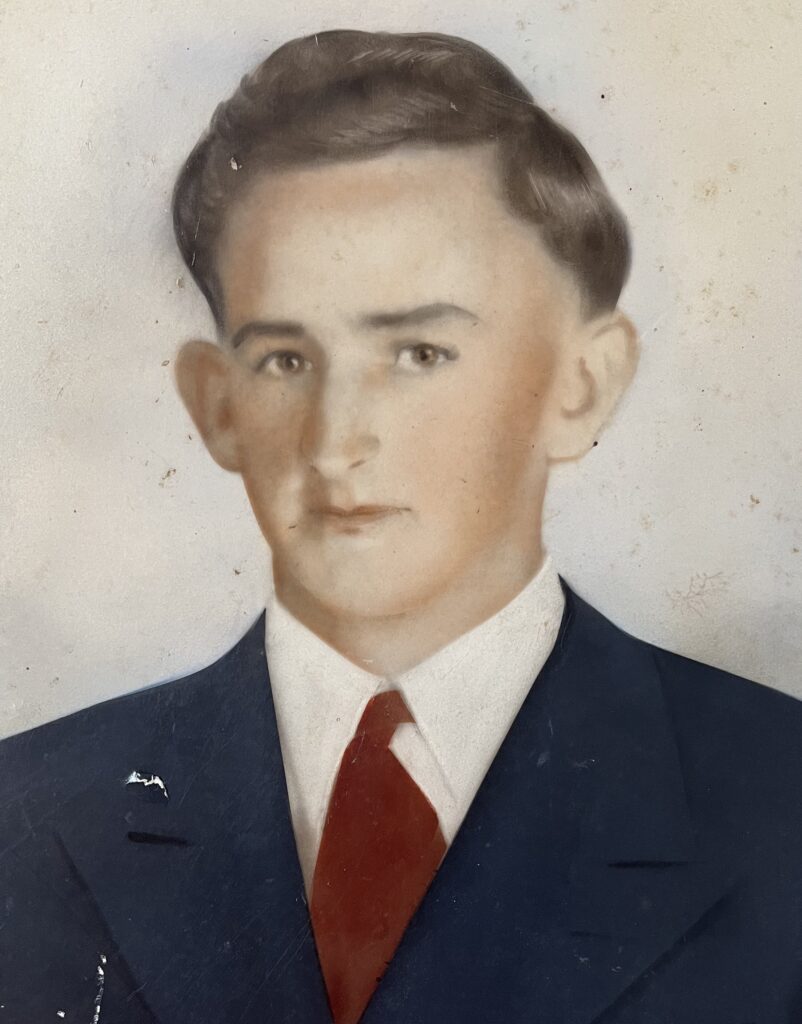
Darcy was born at Gloucester on 13 November 1927, the 3rd of 4 children to Victor and Lena Sansom.
Unfortunately, Darcy would not know his elder brother Max as he died in infancy. The family lived a hard but enjoyable life on a dairy farm on the southern frings of the township of Gloucester NSW.
Dardy’s schooling commenced at a 1 teacher school at ‘Forbesdale’ after which he went to Gloucester High School. The children’s mum died in the last weeks of Darcy’s first year there and tragically, shortly after his father died. The farm was sold and the children were fostered with relatives. Darcy moved to Newcastle to be with his grandmother, and aunt and cousins where he attended Central District High School at Broadmeadow.
Leaving school at 14, Darcy’s first 2 years of work were at BHP steelworks before his uncle offered him work on a dairy farm outside Newcastle. He moved back to Gloucester when another relative offered work on their dairy farm.
After his 21st Birthday he and a couple of friends decided to take off on a working holiday around Australia on their motor bikes. After about 18 months on the road, rumblings of conflict in Korea emerged and they returned home where he and friend Bob Westley enlisted in the Army .
In 1945 Australia sent three units to Japan as part of the British Commonwealth Occupation Force (BCOF). Originally known as the 65th, 66th and 67th Infantry Battalions, they were raised from Australian divisions stationed in New Guinea at the end of the Second World War. On 23 November 1948, the battalions were renamed the First, Second and Third Battalion, The Australian Regiment, respectively. The prefix “Royal” was granted by King George VI on 31 March 1949.
2RAR returned from the Japanese Occupation Force to Australia in 1948 and was stationed at Puckapunyal, Victoria, when the Korean War began in 1950. Some 2RAR members volunteered for service with 3RAR and 1RAR, as these two battalions saw service earlier than 2RAR. 2RAR was bought up to strength with volunteers that enlisted under the K Force recruiting campaign.
The battalion trained for Korea at Puckapunyal. It embarked for Korea on 5 March 1953 on board MV New Australia, arriving in Korea on 17 March. It joined the Commonwealth Division on 21 March, replacing 1RAR at Camp Casey near Tongduchon, South Korea.
2RAR was primarily deployed in patrolling the no man’s land to the north of the UN lines.
Relieving a French battalion, 2 RAR took up a position along the Jamestown Line on Hill 159 and began patrolling in the ‘no-man’s land’ area around the Imjin and Samichon Rivers. This involved making small advances, defending its position, capturing prisoners, collecting intelligence, and maintaining minefields and trenches. The work was monotonous and dangerous, with many casualties caused by mines.
The conditions of this phase of the war, often referred to as the “static phase”, created an additional burden. In winter it was not uncommon for top temperatures to be below zero, and troops had to take precautions against frost-bite and trench foot. At the other extreme, summer was humid, with heavy rain that often flooded the trenches. Added to this were possible attacks from the enemy coupled with shell and mortar fire.
His sister’s, who were working in Newcastle at the time were devastated when contacted by the War Office. A memorial service was held at the Gloucester Church of England which was packed to capacity and a memorial stone was placed with his parent’s graves near his brother Max.
He served 51 days on active service when he was killed in action on the 6 May 1953 at age 25 years. Originally interred at Tanggok Cemetery. Portion 36 Plot and Row 1 Grave No.2892, Darcy was later reinterred at the United Nations Memorial Cemetery, Busan.
